Northern Bluefin Tuna (Thunnus Thynnus), Critically Endangered
I'm in Japan for my brother's wedding, and I almost cried. Not because of the wedding. Because of the Bluefin Tuna.
The Bluefin Tuna, known in Japan as Hone Maguro, is prized as a delicious morsel of sushi and is extremely popular. I went down to the Tsukiji Fish Market in Tokyo, the largest wholesale seafood market in the world, two days ago, hoping to get a glimpse of the auction where the Tuna are sold. The Tuna auction (and the entire wholesale portion of the market) was closed to tourists, so my family and I snuck in. Walking past aisle upon aisle of Shellfish, Molluscs, and hundreds of Fish species, I was appalled to see a sign for a booth selling Whale. My mother reminded me that fishing was in my heritage (I'm half Japanese), and I felt ashamed.
Though I only managed to get a few glimpses and blurry photographs of the rows of frozen Tuna bodies as the guards were escorting us out, I was sad and angry that we are still killing and eating a species that is so close to extinction.
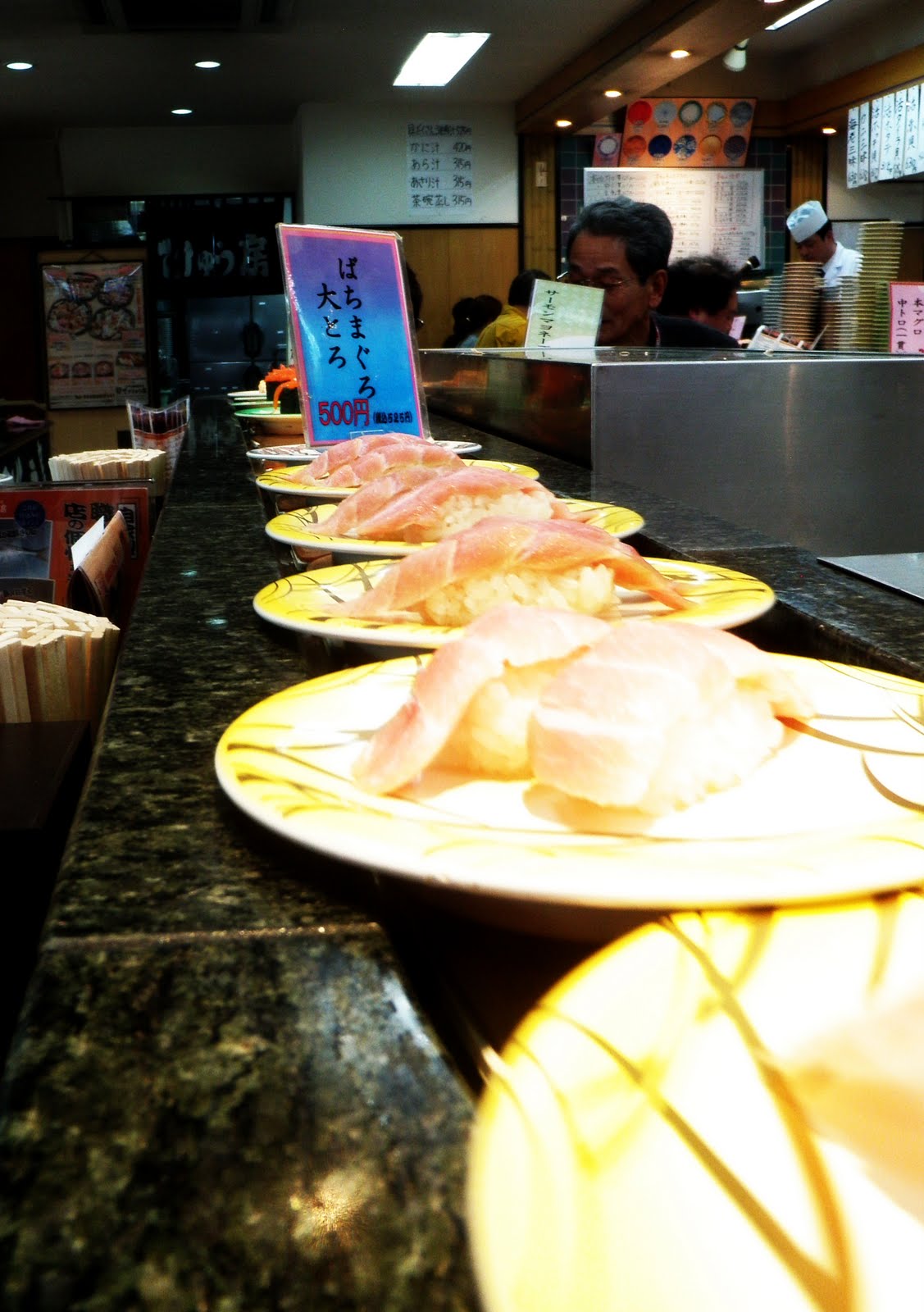
The next day, I went to a sushi restaurant with my aunts, grandparents, uncles, brothers, nieces, parents, and sister-in-law. Several of them selected slender cuts of Bluefin as they scrolled by on the moving conveyor belt. They hid their eyes from me in joking half embarrassment as they downed the delicious morsels. That's when I almost cried.
Experts estimate that sometime in 2012 (2012!!!) the Bluefin Tuna will pass the point of no return on the road to extinction, unless something changes.
If you want to help make the change and stop the extinction, support these guys. They're going to make a direct last ditch direct effort to stop illegal fishing, since much of the Tuna sold on the market is caught illegally. They also made the animation at the start of this post and are working on several other campaigns to raise awareness about our impact on the Bluefin Tuna.
For a broader scale impact, support WWF, who are working from a more political angle to stop the unsustainable fisheries practices.
Also, please, stop eating Bluefin Tuna. I don't want to cry.
Showing posts with label Cetaceans. Show all posts
03 May 2011
11 December 2009
Viva Vaquita
Vaquita (Phocoena sinus), Critically Endangered
A new taskforce has been formed to prevent the extinction of the Vaquita, the world's rarest marine mammal. Check out the Viva Vaquita website for more information.
Here's a recent article about the latest happenings in the world of the Vaquita.
A new taskforce has been formed to prevent the extinction of the Vaquita, the world's rarest marine mammal. Check out the Viva Vaquita website for more information.
Here's a recent article about the latest happenings in the world of the Vaquita.
09 April 2009
Population Explosion, Kind Of
Irrawaddy Dolphin (Orcaella brevirostris), VulnerableIn early April, the Wildlife Conservation Society announced that a population of close to 6000 Irawaddy Dolphins has been discovered in Bangladesh. Before the discovery of the populations in Bangladesh, only a few small pockets of dolphins were known, most numbering less than 150. In short, the dolphins from Bangladesh have increased the known population more than six times.
Brian Smith, who led the study, expressed optimism for the future of the Irrawaddy Dolphin, but cautioned that the many threats still exist, including entanglement in fishing nets, declining freshwater supplies, and climate change.
The Wildlife Conservation Society is working with Bangladeshi officials to create a sanctuary for the dolphins in the mangrove forests where they live.
Keep your fingers crossed if you want to help the Irrawaddy Dolphin. Or you can take action and send an email to your Congressperson (if you live in the US), or support the WCS in their mission of Saving Wildlife.
Thanks to Colie for sharing the news.
19 October 2008
Hector's Dolphins Still Unprotected
Hector's Dolphin (Cephalorhynchus hectori), Endangered
A new study by researchers at New Zealand's Otago University has added to the mountain of evidence that Hector's Dolphins are being killed at a rate that will lead to their extinction . . . unless something changes. These dolphins, with their uniquely rounded dorsal fins, are declining due to commercial and recreational fishing using gill nets and other methods that entangle them as bycatch.
Hector's Dolphins have the most limited range of any cetacean, except the Vaquita. Living only around the coast of New Zealand's two islands, they are divided into two subspecies. The South Island Hector's Dolphins have been reduced to less than 7500 individuals, while the Critically Endangered North Island subspecies, also known as Maui's Dolphins, have been reduced to a mere 110 individuals.
The New Zealand government has restricted fishing in parts of the Dolphin's range, but complete protection has not been realized, partially because of resistance from the fishing industry.
If you want to help, you can petition the New Zealand Government to enact full protection, adopt a Hector's Dolphin through WWF New Zealand, or join a Facebook Cause dedicated to the Hector's and Maui's Dolphins.
A new study by researchers at New Zealand's Otago University has added to the mountain of evidence that Hector's Dolphins are being killed at a rate that will lead to their extinction . . . unless something changes. These dolphins, with their uniquely rounded dorsal fins, are declining due to commercial and recreational fishing using gill nets and other methods that entangle them as bycatch.Hector's Dolphins have the most limited range of any cetacean, except the Vaquita. Living only around the coast of New Zealand's two islands, they are divided into two subspecies. The South Island Hector's Dolphins have been reduced to less than 7500 individuals, while the Critically Endangered North Island subspecies, also known as Maui's Dolphins, have been reduced to a mere 110 individuals.
The New Zealand government has restricted fishing in parts of the Dolphin's range, but complete protection has not been realized, partially because of resistance from the fishing industry.
If you want to help, you can petition the New Zealand Government to enact full protection, adopt a Hector's Dolphin through WWF New Zealand, or join a Facebook Cause dedicated to the Hector's and Maui's Dolphins.
Subscribe to:
Posts (Atom)