15 November 2013

Spreading Awareness About Water Voles To Help Stop Their Decline

The following is a Guest post by Ross Stevens, on behalf of Total Ecology who undertake surveys for water voles and otters at http://www.totalecology.com/mammal-survey/. Thanks Ross!

Water voles finish their breeding season in October. From then on, throughout the autumn and winter, all the territories that have been created and defended throughout the spring and summer cease to exist. Many of the tell tale signs of water vole activity disappear, including latrines. Latrines are piles of flattened droppings that an adult will uses to mark its territory and these are maintained throughout the breeding season.

Water Voles don’t hibernate. They remain active through out the cold months, however they spend most of their time underground within their nest chambers. In winter the colony will often contract, so that adults that were previously territorial now live side-by-side within the same burrow system. They normally choose a place where they will be safe from flooding, where they can dig burrows higher up the bank sides away from the waters edge. If winter grounds are not chosen wisely then a severe winter flood can result in a whole colony of water voles being flooded out and lost. In this situation, if they don’t actually drown, then they are usually picked off by one of the many animals that feed on them. The most famous water vole predator is the American Mink, which escaped or was released from fur farms during last century and is now widespread throughout the country. 

Flooding is not the only problem a colony will face over winter. Less vegetation means less cover to protect them from predators, but more importantly it means less food. Water voles will eat a wide variety of plants, however tree bark, especially willow, provides an important food source in winter. It’s at this time of year that water voles will also turn to the roots and bulbs of plants in order to survive the winter months and in autumn fallen fruits are a favourite. 

A whole colony living in one place makes them far more susceptible to persecution. Water voles are far larger then field voles, bank voles and mice. They are only slightly smaller then a rat, so are far too often mistaken for one. Colonies of water voles are often dug out, or poisoned, or killed by terriers. Thought to have undergone a 94% decline, the water vole is now one of the most threatened mammals in the country. This harmless vegetarian does not spread diseases like rats do, so please think carefully before putting poison next to a watercourse or any water body. 

It is thought that a water vole needs to obtain a weight of at least 170g in order to survive the winter. This means that those born earlier in the year have better chance of survival. A water vole rarely survives more then one winter, but very occasionally they may survive 2 or even three. All in all, it seems that winter is a hard time for a water vole. It is actually thought that up to 70% of a colony is lost over winter, leaving just a few individuals to set up breeding territories again in March.

10 August 2012

Conservation success and the paths we're taking. (at SCB Asia 2012)

Over the course of yesterday and today various scientists and students provided the same window into conservation in Asia:

Small interventions are sorely required but the way we view professional success is not really compatible with small 'drop in the pond results' as scientists.

Should roles be clearly defined? Scientist, managers and implementers for wildlife. Also the term "implementer" - who is this person? a forest patrol beat guard? a policy worker? a manager could be one?

Should scientists have to extend themselves to be all? "Is today's conservation solution tomorrow's conservation mistake?" - maybe in some instances, but we don't have a choice and hopefully we will make different mistakes each time and be wiser for it.

Many times people-wildlife friction was also in the forefront. A show of hands we realized only maybe 10% of the audience fell in the following rough criteria - policy workers, government representatives and social scientists. But I would like to point out that with the number of times human-wildlife strife was highlighted at a conservation biology conference would signify that the gaps between these groups is smaller than we imagine. A larger problem - not highlighted is the lack of / mis - governance.

While the scientific community disseminates conclusive results for the conservation of nature it cannot extend itself to form societal decisions of prioritizing wins and losses. Here public and government buy-in come in to play. We know this. Should we be convincing? YES. Should we ally with similar value based people in other fields? YES.

And so - is conservation science objective? ... ? Most people felt they could not longer say 'yes' to this question. But I disagree. Scientific research by definition is objective, how the outcome is used is much less so. (Usually at this juncture someone points out the hole in the argument that should leading scientists be held responsible for the destruction caused by atomic bombs... I think that is an entirely different question of what science interests you and personal ethical codes.)

Large gnarly issues were voiced - where is conservation attention and resources spent? should we be picky about funding bodies or who works with us on research depending on their value and ethical code?

Another point to note here would be - conservationists must be afforded credit in ways that other applied science workers are apart from peer review publications. I think peer reviewed articles are still a standard, but should not be held up as the only critical measure of success as a conservationist. This becomes especially true in places where large gaps exist and little support can be found for education and journal access alongside eking out a living.

This morning, a suggestion for a regional / country specific conservation think tank to be formed what floated by Kashmira (plenary speaker) - to make sure reports reach policy workers and decision makers. To hold and make public this information in a collated but transparent manner. So that a community of "conservationists" {including scientists, policy workers, decision makers, government office holders and public patrons/volunteers/interest groups...} may have a stronger voice influencing policy.

08 August 2012

Biodiversity Asia 2012 : Day 2 : Talking Science

Day two of the SCB Asia regional conference brought with it a packed schedule and much running around as a few of us attempted to make it to various talk in parallel sessions. Some even tried this between the speed talks (!). Today for me turned out to be all about megafauna - the BIG animals. Tigers - Indian and Siberian, elephants, dholes, leopards their distributions, their populations, degrading connectivity and maintaining genetic pools. Very heavy with models and statistics that conclusively provide enough scientific motivation to employ these results in policy.

Talking (yes, still) about the snippets that I noted and remember will be a jumble if we do this chronologically. So instead I am going to go topic wise.

Tigers - Russian conservation efforts need to see that large biomass prey base remains intact because these cats cannot afford to spend energy to hunt the required number of smaller prey across a year. Tigers in India - they traverse across the larger agricultural matrix quite well and novel ways are being used to look at the existing populations. The routes they take are sometimes quite surprising with a few protected areas for tigers being completely avoided (!) and some parks behaving like a "bus stop" with a large amount of inflow - outflow. Connectivity will have to be more seriously looked at and factors defining some protected ares not being used must be addressed to have a better handle on the conservation of the same. Also in tiger habitats a great deal can be and has been achieved through local peoples trained in survey methods.

Leopards - exist in extensive farmland and may be culture shocked when caught and relocated to a forest where they must learn what is prey and deal with forest structural factors of a thick canopy or non-crop vegetation. Maybe even the total absence of people may throw them off track. Maybe this happens only in India. We should remember cats are territorial and empty lots get taken off the market - so relocation may just swap individuals around. Relocation we're now finding may increase human-big cat conflict (at least with leopards). Townie leopards should probably not be released in the wild.

Elephants - populations being blocked in by private estates and corridors shrinking seasonally may not be the only changes they are finding hard to cope with. A road that is almost entirely as a linear barrier (too steep sides + human settlement concentrations) may require us to build viable overpasses. Needless to say - science must govern the placement of such measures, not administration and certainly not human convenience.

Other large carnivores - Canids being threatened by distemper carrying stray dogs and roaming outside of parks are often the very populations that provide for genetic mixing. Populations within parks also are increasingly being affected by hard edge affects - much larger for some taxa (sometimes extending beyond 6kms inside a forest from the edge). Conservation for large mammals across the region will have to consider measures that involve human dominated landscapes in a bid for healthy populations of large carnivores.

Peppered among the 'big carnivore day' today were science findings such as - 
- Economic approaches to solving people-park situations fail in long term as attachment to land and way of life are rarely adequately compensated.

- Biodiversity of taxa like birds and amphibians largely fall through the net of protected areas and have have a lot less ability to bridge fragmentation gaps. These taxa therefore are under great peril even and especially in biodiversity hotspots where human pressures on non-protected land are converting as much habitat as legally possible.

- Vultures: the fight against Diclofenac use for cattle continues unabated and must remain the top priority for the many species of vulture to survive.

- Lion Tailed Macaques are in dire need of canopy connectivity between populations especially to facilitate males to get around.

- A study on forest and tea estates in Manipur found that ambient air temperature warming causes more carbon flux. (Initial findings that need more spatial and seasonal replicates that may point to these key habitat's source and sink functions for carbon storage)

A take-away from yesterday that got reiterated at the closing of today's sessions after a ride of different species and places and wholly ecological in nature: Politics, Economics, Society, Cultures - ALL of this has to be the purview of conservationists. The science has to play out in policy and governance (see what I did there for this regional's theme?). Maybe tomorrow will be a day of acting on all the parallel, collaborative and required momentum today generated to crystallize ideas and future course of conservation in the region.

Also most posters went up today (click the image to view pdf):


07 August 2012

Biodiversity Asia 2012: Science, Policy, and Governance - Day 1


The 2nd Asia Regional Conference of the Society for Conservation Biology – Asia Section kicked off today. I can only represent here the bits I attended and / or was part of so bear with some missing parts from this conference in blog posts over the next few days (read - till I keep writing / maintain a semblance of daily reporting)...

Attending a great pre-inauguration workshop on criteria for identifying Key Biodiversity Areas (KBAs) set the stage of what I am expecting for the rest of the conference. The 3 speakers were Tom Brooks, Diego Juffe and Jagdish Krishnaswamy. The session was chaired by Dr. Vinod Mathur who managed the time and a long and interesting Q &  A session - excellent.

Going over the main driver of biodiversity extinctions - habitat loss, the history of taxa specific site identification criteria - BirdLife's Important Bird Areas (IBAs), Important Plant Areas, Prime Butterfly Areas and the Alliance for Zero Extinction as a starting point of information that already exists gave a good idea that KBAs were not set to be the new improved system, but a framework to provide a global standard way to identify critical sites for biodiversity conservation. Add to this irreplaceability of a species, ecosystem or space and vulnerability measurements and you have the crux of the argument for KBAs.

Sure, there are limits to using KBAs as a biodiversity conservation approach - clearly elucidated by Tom in his presentation. Using KBAs as a box to put all biodiversity in and expecting that to work would be disastrous - imagine trying to fit migrations, source and sink locations of a threatened species (and maybe even getting that the wrong way around due to the criteria largely being for a congregation / large abundance - present both at source and sinks ! ), the choices we make using available data vs actual data and the turnaround time updating a large number of local sites may require if the criteria / data change over time... 

But my fundamental reservation lies elsewhere with the idea of KBAs and is borne out of advocating for IBAs (successfully in regions with strong legal support or local community buy in, dismal in ignored or prime large development real estate)...

Part of the work undertaken in forming KBA criteria will also evaluate how well we have done for species using protected areas. There are only two ways this study could go (assuming it won't be inconclusive) -

If we've done far worse than we thought we would - then does it make sense to layer another framework over the existing ones that are flawed (in their inherent mechanisms / their implementation)?

OR 

If we've done better than we thought we would - how are non official frameworks contributing to this conservation of biodiversity?

I suspect in a country like India, as across much of Asia, hungry for economic growth - integrated planning is far removed from involving corporate sector, government, large development, peoples with even a a passing thought for biodiversity. EIA clearances are formalities and the increasing pressures of large development dwarf the chance for ecologists to make their foot-in-the-door remarks about ecosystem functioning / services and biodiversity value.

It would be very interesting to compare conservation results from places that have afforded frameworks like Key Biodiversity Areas official and legislative importance with places that have spent a bulk of their scientific and policy resources in solely strengthening existing protected areas conservation. That would make clear if we need to invest more in evaluating our present systems and then may be providing an adequate amount of scientific study to solving these roadblocks through good practice and maybe even global standards.

**  This part between the morning session and the evening public lecture provided a little rain, a lot of foraging exploration around the conference venue and setting up my poster (more on that later)**

Evening public lecture: A real treat of a talk filled with witty jokes and more importantly the passion to drive home the point of largely how we react as humans / as a society to something as abstract and destructive as global climate destabilization by Dr. David Orr. I particularly loved his analogy of how if a tiger walked on to the inaugural stage we'd get pumped, use our fight vs flight instincts and DO something. But a slide clearly stating that food will get undoubtedly scarce if we allow the next 30 yrs to go by as BAU (business as usual) doesn't bring forth any fidgeting, mad screaming, running out of the doors or pushing someone else into the "tiger's mouth" !   :D

08 December 2011

What will happen to Peter's chameleon?

Petter's chameleons (Furcifer petteri), Vulnerable.

Back in the dry season of 2007 on the very northern tip of Madagascar, our favourite nightwalk victim became sleeping Petter's chameleons (Furcifer petteri) {Peter/Petter wasn't asleep the chameleons were).

Attributed as a defense mechanism these chameleon climb to the furthest parts of branches and curl their prehensile tails around branch before they nod off. If predators come along the branch tip is more shook up than the rest and either the chameleon wakes up or falls off to be rudely awakened once it hits the ground.

IUCN classifies them as vulnerable but this is largely due to our lack of knowledge how fragmentation affects this species. We found them in a patch of dry deciduous forest fairly close to the coastline, they have also been found in survey of two national parks - Mt. Ambre (wet montane) and Ankarana (dry and full of limestone karst).

The problem is that we don't know if they can bridge the expanses between these sites and if they have been isolated for too long to provide a healthy population. Most likely, they are severely impacted by deforestation and survive in small pockets of remaining habitat.

Another confounding thing about the Petter's chameleon, true also for other species, is that juveniles are too easily confused with similar looking species. We just don't know enough about them or their lives to make even rough estimates of habitat requirement, sensitivity to human disturbance / cattle disturbance. Species range is also loosely defined for these chameleons.

What I do know is that they are the least stressed out/nasty when being handled, will hold onto a pencil like a security blanky while you weigh them and measure lengths. Sexing adults is easy peasy for the Petter's chameleon - males have you-can't-miss-it nasal protrusions (refer picture). These were also the first chameleons that I saw with PINK on them - they put on trippy color shows.

We definitely need to assess what species remnants of northern Malagasy forests harbor and how best we can connect fragments across the agricultural landscape. Especially now when Madagascan biodiversity is more threatened than ever before (with the last political coup and rampant harvesting of illegal hard wood from pristine primary forests).

Here's a pic of one of them lounging on the camp fence after spending a night on camp with us.


28 September 2011

Endangered Eating

Check out this great blog post from Eating . . . Our Words, a blog hosted by Houston Press. It details ten species of endangered fish that are still commonly eaten, and asks the question "Why are we still eating species that are on the verge of collapse?"

10 Fish You're Eating That Are Endangered Species

Here's a list of different organizations and advisories focusing on sustainable seafood choices.

22 June 2011

Responsible Reading

Tasmanian Devil (Sarcophilus harrisii), Endangered


Check out this anthology of 'speculative fiction.' Titled Extinction Doesn't Mean Forever, the stories are themed around extinct or imaginary creatures returning to the modern world. The authors have decided to donate the profits earned between July 1 and July 15, 2011 to help save the Tasmanian Devil.

Download a copy of their book during those two weeks and you can help prevent the extinction of the Tasmanian Devil.

Check out these previous posts on the Tasmanian Devil to learn what's been causing their decline, or check out the Save the Tasmanian Devil website for the latest news and information.

03 May 2011

Bluefin Blues

Northern Bluefin Tuna (Thunnus Thynnus), Critically Endangered

I'm in Japan for my brother's wedding, and I almost cried. Not because of the wedding. Because of the Bluefin Tuna.


The Bluefin Tuna, known in Japan as Hone Maguro, is prized as a delicious morsel of sushi and is extremely popular. I went down to the Tsukiji Fish Market in Tokyo, the largest wholesale seafood market in the world, two days ago, hoping to get a glimpse of the auction where the Tuna are sold. The Tuna auction (and the entire wholesale portion of the market) was closed to tourists, so my family and I snuck in. Walking past aisle upon aisle of Shellfish, Molluscs, and hundreds of Fish species, I was appalled to see a sign for a booth selling Whale. My mother reminded me that fishing was in my heritage (I'm half Japanese), and I felt ashamed.
Though I only managed to get a few glimpses and blurry photographs of the rows of frozen Tuna bodies as the guards were escorting us out, I was sad and angry that we are still killing and eating a species that is so close to extinction.

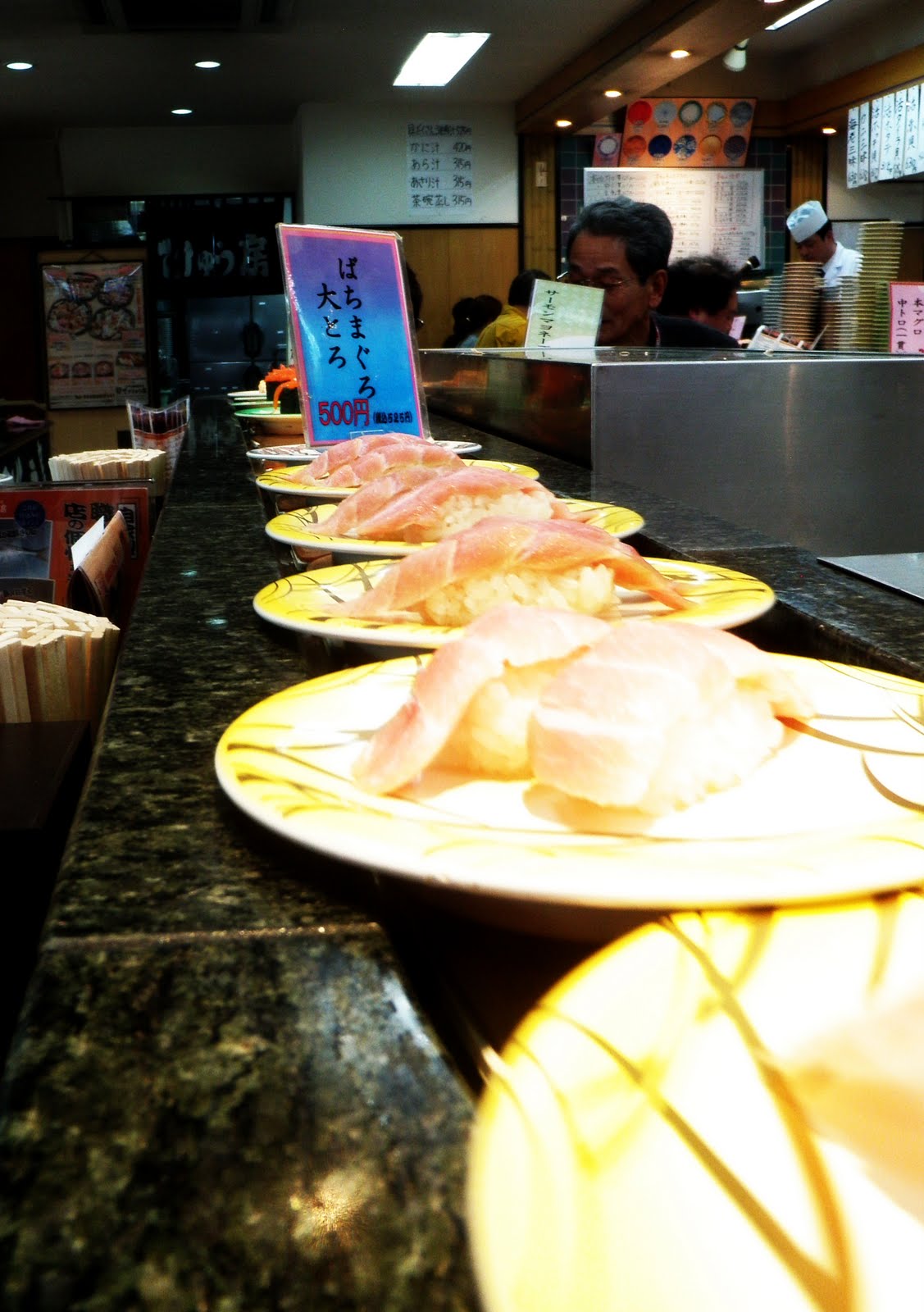
The next day, I went to a sushi restaurant with my aunts, grandparents, uncles, brothers, nieces, parents, and sister-in-law. Several of them selected slender cuts of Bluefin as they scrolled by on the moving conveyor belt. They hid their eyes from me in joking half embarrassment as they downed the delicious morsels. That's when I almost cried.

Experts estimate that sometime in 2012 (2012!!!) the Bluefin Tuna will pass the point of no return on the road to extinction, unless something changes.

If you want to help make the change and stop the extinction, support these guys. They're going to make a direct last ditch direct effort to stop illegal fishing, since much of the Tuna sold on the market is caught illegally. They also made the animation at the start of this post and are working on several other campaigns to raise awareness about our impact on the Bluefin Tuna.

For a broader scale impact, support WWF, who are working from a more political angle to stop the unsustainable fisheries practices.

Also, please, stop eating Bluefin Tuna. I don't want to cry.

19 April 2011

Numbat Numbers

Numbat (Myrmecobius fasciatus), Endangered

Having just spent several months living and working in Australia, Australian species are especially interesting to me right now. Koalas, Kookaburras, and Kangaroos all crossed my path, as did Wallabies, Wattles, and Wombats. What didn't cross my path was a small creature known as a Numbat. This is likely because the Numbat is no longer common in the state of Victoria, where I spent almost all of my time.

Numbats used to live all across the southern regions of Australia. Their population was reduced to two tiny pockets in the state of Western Australia after the introduction of foxes. Since then, it has been reintroduced to a few small conservation areas, but still numbers less than a 1 000 animals in the wild.

The Numbat diet is a little bit monotonous, consisting of nothing but termites. Each individual can eat between 10 000 and 20 000 termites in a day! Unlike many other termite eating animals, however, Numbats are small, and lack claws or any other method to open up termite nests. This means that they have to forage for termites when the termites themselves are out of the nest foraging--that is, during the day--making it one of the very few marsupials active during the day. Being active during the day like this is thought to make them more susceptible to predation.

In the evening, when they aren't foraging, these rare marsupials retire to their burrows, which are very often inside of hollowed out logs. It is thought that an abundance of hollow logs to hide in may have saved the two groups of Numbats that survived in Western Australia, as they provided protected hiding places from predators.

These stripy furry animals are cute, no doubt about it. They're one of Western Australia's State Emblem's, and they've also been chosen as the icon for the Conservation Council of Western Australia. A captive breeding and reintroduction program is underway, and Numbats are bred at Perth Zoo and released each year into managed habitat. Here's a great video about hand-rearing baby Numbats at the zoo.

If you want to help Numbats, you can donate to Perth Zoo's Wildlife Conservation Action.

22 January 2011

Yaminon


Northern Hairy Nosed Wombat (Lasiorhinus krefftii), Critically Endangered

This cute-ish animal is critically endangered. Endemic to Australia, it's range has steadily decreased, until in the early 80s, there were only 30-40 individuals in tiny Epping National Forest Park, about 800 km northwest of Brisbane. In 1982, Cattle were excluded from their habitat, and their population has risen to over 130.


In May of 2009, a number of Wombats were moved from Epping to a newly created nature reserve, just north of St. George, providing some protection for the species. The biggest threat to the species is a catastrophe such as fire, flood, drought, or disease, that could wipe out the entire population. Having two separate populations is a bit of a disaster insurance policy.

This largest of Wombat species, also sometimes referred to as the Yaminon, is now protected in both locations by predator proof fences to keep out dingos and other predators. Conservationists managing these populations engage in reproductive and behavioural research, as well as controlling invasive species of grass, controlled burns of habitat, DNA studies to estimate population (by collecting hair samples with tape), and much more.

If you want to help out this nearly extinct animal, here's some ideas:

You could of course donate to the Wombat Foundation.

Or you could buy some children's books featuring Willit the Amazing Wombat.

Most importantly and least expensively though, you could learn more about the Northern Hairy Nosed Wombat, and then tell your friends.

Here are some very informative sites:

From the Queensland Government.
From Evolutionarily Distinct and Globally Endangered (EDGE).
From the Wombat Foundation.

13 December 2010

Gharials Reclaiming River?

 © Sanjib Chaudhary
Gharial (Gavialis gangeticus), Critically Endangered

The Gharial, a critically endangered crocodilian, survives only in fragmented habitats throughout India and Nepal. In the past, it also occupied rivers in Pakistan, Bangladesh, Bhutan, and Myanmar. It's current population is thought to be a mere 200 individuals.

Good news then, that it has recently been seen in places where it hasn't been for 40 years or more--the Hooghly District (near Kolkata) on the Ganges River in India.

iREBEL, a conservation organization, and Innovative India Tourism Pvt. Ltd, teamed up with other partners to conduct surveys in the area after hearing Gharials had been sighted there. They discovered a viable breeding population in a 170 km stretch of the river.

The group hopes to establish reserves along the river to protect the Gharials, as well as Gangetic Dolphins and other species living in the area, as many threats still face these nearly extinct and beautiful crocodilians.

The main threats to Gharials are outlined in a report published by the group:

1. Fishing – especially with gill nets and set nets. Juvenile gharials often become entangled and die.
2. Destruction of sandbanks for use in brick factories
3. Disturbance by humans while basking in the sun
4. Industrial pollution
5. Perception that gharials are man-eaters like other crocodiles

If you want to help, you can support the gharials through eco-tourism. You can sign up for wildlife tours with iREBEL, Innovative India Tourism Pvt. Ltd, or WWF-India, or even volunteer to help with their work.

You can also support the Gharials through the Gharial Conservation Alliance.

17 November 2010

Blogs Galore

Check out these two great articles over at Vet Tech. NEY made the list at number 4 on the top 101. Also check out some of the other blogs mentioned. Thanks Vet Tech!

Top 101 Blogs to Inspire You to Protect Endangered Species

50 Inspiring Blogs Fighting for Endangered Species

14 November 2010

Orange Bellied (Yellow Breasted Green Headed Blue Winged) Parrot

Orange Bellied Parrot (Neophema chrysogaster), Critically Endangered
Photo copyright Dave Watts
The Orange Bellied Parrot is sick, and this is a really bad time to be sick.

With a mere 50 or so individuals surviving in the wild, this species is edging closer to extinction every day. For the past few years, the wild population has been estimated between 140 and 180 birds--a steep decline from 'common, or locally abundant' in the 1920s. Only in the past year have the numbers dropped even lower as sightings of wild birds have grown fewer.

Three captive breeding populations exist in zoos around Australia, and it's these unfortunate Orange Bellies that are sick. An unknown virus has infected birds in the captive breeding program, causing some of them to lose their feathers and weakening their immune systems. Scientists believe that the virus may spread more easily in the captive population because they are so close to each other. The program has had some success annually releasing captive-bred birds to help sustain the wild population--so if the captive breeding program suffers, so will the wild population.

Orange Bellies are a migratory species, breeding and nesting in southwestern Tasmania, and spending the rest of the year in coastal areas in South Australia, Victoria, and New South Wales. This month is migration month, and all wild Orange Bellies are making their way south to Tasmania, where mated pairs will build nests and lay 2-6 eggs.


Of course, these parrots also face the usual threats of habitat loss and invasive species. You can learn more about their food, habitat, life cycle, and what's being done to help them here. If you live in Australia and want to help, you could volunteer with Birds Australia.

28 September 2010

3000 Frogs Isn't Very Many


Photos courtesy of Frogwatch.

White-bellied Frog (Geocrinia Alba), Critically Endangered

Sixty White-bellied Frogs are now exploring their native habitat for the first time, after being released into the wild last week. These glossy bellied frogs live only in the province of Western Australia, where they have the dubious distinction of being this region's only critically endangered frog species.

The total population of all White-bellied Frogs is estimated at less than 3000. This might be an impressive number if you were talking about Facebook friends or gigabytes of data, but when you're talking about the entire population of a species, 3000 equals hanging by a thread.

They are mostly being affected by habitat loss, and a related problem, habitat fragmentation. As humans encroach on their living space, they also divide it. These frogs are known to exist in 56 subpopulations, with no movement between any of the groups.

This latest release is the first time young frogs (aka froglets) have been introduced to the wild from the captive breeding program run by the Department of Environment and Conservation. Transplantations of large numbers of eggs have occurred, but the results of this new approach will help scientists determine the best methods of helping boost the population of this unique amphibian.

Check out the Amphibian Ark--an organization dedicated to helping endangered frogs all around the world.
Read more details here or some technical data here.

12 February 2010

It's a Big Problem


Basking Shark (Cetorhinus maximus)
(Photo courtesy
www.sharkireland.com)

The Basking Shark is endangered in the Pacific and in trouble in the Atlantic (
COSEWIC 2007, listed as vulnerable by the IUCN) and is little known by most humans. A call to our lab to determine which “sea monster” carcass had washed up on a Nova Scotia shore had us discover a Basking Shark that had apparently died at sea.

These gentle giants can grow up to 15 metres in length and have the longest known gestation period of any vertebrate (up to 3.5 years!), so replacement is low. Despite their size, I think Basking Sharks are pretty cute. First, they’re filter feeders, so the fear factor is totally related to being humungous and able to knock your head off with a casual flip of the tail. Second, their rounded noses make them look a bit more like a seal than a shark. Unfortunately, they can become tangled in nets and fishing lines or hit by ships as they cruise near the surface of the water, feeding on the rich biodiversity of plankton there.

I’ve been up close and personal with a lot of Atlantic sharks, and their sheer bulk makes them seem invincible. They aren’t. In the pacific, the situation is
even worse.

What can you do to help them out? As with any ocean fish, this is a tough question. Avoiding
cruise ships is a good first step, but minimizing your contribution to water pollution (salts, fertilizers, sewage? learn more here) and eating a vegetarian diet (slower global warming and no nets or lines to tangle or maim non-target species) are even better. Finally, tell your friends! We’re the species responsible for their decline, so we can certainly act to change that.

22 January 2010

Splash! Puurrrrr.

Flat-headed Cat (Prionailurus planiceps), Endangered

An awesome article from New Scientist, about a water-loving cat with webbed feet.

21 January 2010

IYOB

The year has just started, but already one month has already nearly passed. The rest of the year will be gone before we know it, and soon it will be December once again.

Despite how fast this year will go by, there are plenty of opportunities to make a difference. The UN has designated 2010 the Internatial Year of Biodiversity (IYOB), to celebrate all of life of earth, and the ways in which our lives are enriched by it.

In order to promote biodiversity and raise awareness of endangered species, the International Union for Conservation of Nature (IUCN) is highlighting a species a day. There's a link to the Species of the Day to the right, so follow along and learn a bit more about some of the threats facing the biodiversity of our planet.

Click here to find a IYOB celebration near you.

18 January 2010

'Alalawhat?

'Alala (Corvus hawaiiensis), Extinct in the Wild

The 'Alala, has been Extinct in the Wild since 2002. What is an 'Alala you ask? 'Alala is the Hawaiian name for a bird that others call the Hawaiian Crow.


The last few wild birds lived out their lives on the island of Hawaii, in the Kona Forest Unit of Hakalau Forest National Wildlife Refuge. Now, the 'Alala no longer exists, except for sixty some birds in two breeding centers, (one on Maui and one on the Big Island of Hawaii), and a single bird at the San Diego Zoo.

The birds declined because of a variety of factors, including habitat alteration by wild cattle, sheep, and pigs. These animals would clear the underbrush of the native plants that the 'Alala depended on for food. The lack of underbrush also made the Hawaiian Crow more susceptible to attacks from it's main predator, the 'Io, aka the Hawaiian Hawk. Logging and the conversion of forested land into agricultural land added to the problem.

Recovery efforts have been underway since at least the 1970s, but with little success. Between 1993 and 1999, 27 captive reared birds were released. Twenty-one of those died in the wild, and the remaining 6 were recaptured to preserve their genetic diversity for the captive breeding program. The captive breeding population has grown over the years, but very slowly.

Currently, a single 19-year old bird is being kept at the San Diego Zoo, where it is hoped that it will be possible to collect his sperm, so that his important genes will not be lost, since he will no longer breed.

In 2009, the US Fish and Wildlife Service published an update to its recovery plan for the 'Alala, including plans for continued captive breeding and eventual reintroduction into conserved and protected habitats. In order to carry out the recovery plan, an estimated $14 million will need to be found.

You can stay up to date on the latest news and information about the 'Alala at Crows.net.

[January 20, 2010, 9:32 pm, corrected the location of the breeding centers in paragraph 2]

04 January 2010

Lost and Found

Forest Owlet (Athene blewitti), Critically Endangered

Happy new year! 2010 and I write about a species lost and found again!

The Forest Owlet existed for only a decade after it was first described before being rediscovered113 (!) years later in 1997. I had the priveledge to attend a talk by one of the discoverers, rather re-discoverers, a few weeks back here in New Delhi.


Pamela Rasmussen is like an adventure book come to life - filled with a long tale of controversies, mysteries and finally the finding of a SPECIES! A dream all nature explorers and adventurers carry from childhood. So here is the story of the Forest Owlet as I recollect it.


This Owlet was never prolifically observed and a tumbling and twisting tale of specimens follow its course in history. The search only had a few specimens in various museums to follow as a lead. So put on your Detective Cap and follow on - soon these specimens were studied and a tangled web of specimen fraud was unraveled starring in the lead role a Colonel Richard Henry Meinertzhagen a British soldier, an intelligence officer and an ornithologist. Once the truth slipped out and after many a long and hard survey a few tiny patches of forest in India in the Satpuras were found to house these beautiful birds. Its habitat is largely protected in Melghat Tiger Reserve, Taloda Reserve Forest and Toranmal Reserve forest. The key differentiation between notified reserves and reserve forest is the level of actual protection. All 3 places are however under the IBAs of India, broadly strewn across the country and under surveillance by hawk-eyed (or should I say Owlet-eyed) IBCN members. Critically endangered and with ever increasing habitat reduction the Forest Owlet is as closer than ever to vanishing once more than it was a hundred years back!


If you see any Owlet near your garden sunning itself you'll realize the joy of seeing an intelligent predator at their most relaxed... I saw Spotted Owlets (not in danger of becoming extinct) in my garden the other day and it made me think of the Forest Owlet once more.

It would indeed be a shame to lose this bird again after so painstakingly finding it. After all, this time round we may not be as lucky as a hundred years back to see it re-surface again!


You can even adopt this and a few other birds here! This photograph is by Nikhil Devasar.

17 December 2009

Collector's Item

Gooty Sapphire (Poecilotheria metallica), Critically Endangered


The first thing I learned about this tree dwelling tarantula, was that it has to be seen to be believed. When I saw a picture, I understood why. The rare beauty of this spider's color may be its salvation or its doom.

Native to a tiny, tiny, tiny, patch of India, this entire species occupies less than 100 km squared--and that's a generous estimate. Sounds big, but look at this map, and you'll see just how tiny it is.

With it's habitat being degraded as humans cut trees for timber and firewood, it's up for debate whether the smugglers who have spirited some of these spiders out of the country will ultimately help the spiders or cause their demise.

Coveted among spider and insect collectors and hobbyists for their colour, these spiders are being bred in captivity by specialist pet shops. A young Sapphire Gooty spiderling can fetch more than US$150. Although they are fairly rare right now, as hobbyists continue to breed them, they may become more common.

I don't generally support taking wild animals out of their native habitat for use as pets, but perhaps this time it might save them, or at least ensure that some remain if they can no longer survive in the wild.

What do you think? Is this biopiracy or conservation in disguise?